
Costa Rica Regions & Cities: Compare Your Options
Compare six areas for living in Costa Rica: Central Valley, Guanacaste, Southern Pacific, Caribbean Coast, Northern Zone and Nicoya Peninsula. Start with climate, access to services and everyday transport, then investigate specific towns.
Independent planning resource · Verify changing requirements with primary sources
In this guide
These are practical planning groupings, with some geographic overlap, not a list of administrative provinces or official tourism regions. Open the Costa Rica Tourism Board’s downloadable maps to locate places before comparing them here. The Tourism Board uses its own regional groupings.
Compare the six areas side by side · Open the local planning guides
How to use this page
Use the comparison to shortlist areas, then test ordinary weekday journeys and services from an actual address. Conditions vary by town, elevation and season; a regional description is a starting point, not a guarantee.
City and local planning guides
San José, Escazú and Santa Ana: healthcare and local planning
Compare hospital campuses, dental contacts, airport transport and accommodation questions before choosing a base.
- Atenas and Grecia: healthcare and local planning
- Liberia and Guanacaste: healthcare and local planning
Exploring other areas? Start with the Central Valley guide for Atenas and Grecia or the Pacific Coast guide for Guanacaste.
Local planning guides added October 2, 2026.
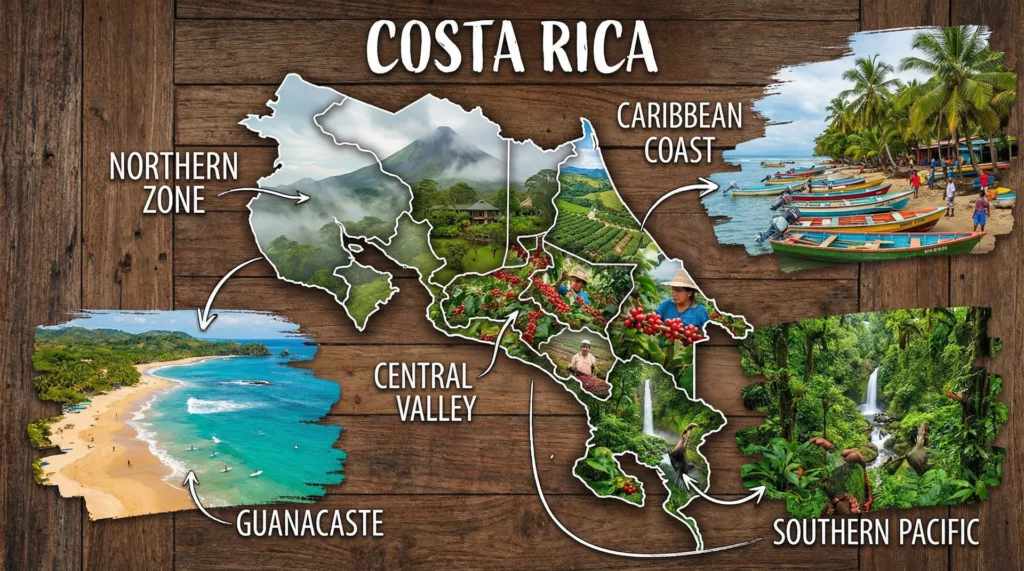
Explore Costa Rica’s Regions
Central Valley
The heart of Costa Rica, featuring a temperate climate, modern amenities, and proximity to San José. Popular towns include Escazú, Santa Ana, and Atenas.
Guanacaste
Costa Rica’s northwest Pacific coast, known for beaches, a dry tropical climate, and established expat communities. Towns like Tamarindo, Flamingo, and Papagayo offer beach living with modern infrastructure.
Southern Pacific
Rainforest and beaches in a quieter, less-developed area. Towns like Dominical, Uvita, and Ojochal attract nature-focused residents. Generally more remote, with fewer services than the Central Valley.
Caribbean Coast
A distinct Afro-Caribbean culture, warm waters, and year-round tropical climate. Puerto Viejo and Cahuita offer a relaxed pace with access to national parks and wildlife.
Northern Zone
The Northern Zone includes warm, humid lowlands around La Fortuna as well as higher locations with different conditions. Compare elevation and local rainfall rather than treating the region as one climate. Arenal Volcano, Lake Arenal, hot springs and outdoor activities are reasons to explore the area.
Nicoya Peninsula
Nicoya has been studied as a historical longevity hotspot, sometimes called a “Blue Zone.” Population research does not guarantee a health or lifespan benefit for someone who moves there, and a 2023 follow-up study found that the earlier advantage had narrowed and shifted geographically. See the earlier population study for context. Beach towns such as Nosara, Sámara, and Santa Teresa attract wellness-oriented residents, but the peninsula is generally more remote than the Central Valley.
Quick regional comparison
Use this as a broad planning screen, not a town-level verdict. Climate, road access, services, and costs can change substantially by elevation, neighbourhood, season, and provider. Verify the specific location you are considering.
| Region | Typical climate | Access to major services | Transport reality | Main trade-off |
|---|---|---|---|---|
| Central Valley | Mild at many elevations; warmer in lower areas | Broadest access to national-level hospitals, government offices, and major shopping | Traffic can be heavy; airport and highway access vary by suburb | Congestion and higher costs in some popular districts |
| Guanacaste | Hot, with a pronounced dry season in many lowland areas | Liberia provides regional services; specialized care may require more travel | A car is often useful outside main towns; Liberia airport helps some locations | Heat, seasonal dryness, and tourism-driven pricing in some coastal towns |
| Southern Pacific | Generally hot, humid, and wetter; conditions vary by elevation | Smaller local centres; advanced services can require travel | Long road trips are common and a car is often practical | Remoteness and fewer services |
| Caribbean Coast | Generally hot, humid, and rainy across much of the year | Limón is the main regional centre; options vary farther south | Road access and travel times can be limiting | Humidity, rain, and distance from Central Valley services |
| Northern Zone | Warm and wet in lowlands; cooler at higher elevations | Regional towns cover daily needs; advanced services may require travel | A car is often useful; distances and road conditions matter | More rain and longer trips for specialized services |
| Nicoya Peninsula | Hot; dry-season conditions vary across the peninsula | Access differs sharply by town; some needs require travel to larger centres | A car is often useful; coastal roads and travel times vary | Remoteness and high costs in some popular beach towns |
Sources and context: Review Costa Rica’s official regional overview, the Instituto Meteorológico Nacional’s climate-region report, and the CCSS hospital directory. These sources help with broad screening; verify town-level conditions separately.
Check local conditions before relying on a regional estimate
Regional ranges cannot tell you the elevation, heat or rainfall at a particular home. Open the National Meteorological Institute’s climate atlas and compare the specific town, elevation and months you intend to stay. Historical climate information is not a forecast. Obtain a current transport estimate between the actual airport, accommodation and appointment addresses, including the return trip and rainy-season conditions.
Hospital names are contact leads, not a determination of the nearest suitable service. CIMA’s official directory lists its hospital in San Rafael de Escazú; do not assume a CIMA campus serves your Guanacaste address. The CCSS hospital directory is the starting point for public facilities. Use our Liberia and Guanacaste planning guide for local contacts, then confirm the facility, appointment and emergency arrangements directly. Regional descriptions do not establish specialist availability, insurance cover or a safe emergency route.
For a more detailed side-by-side of the three zones most retirees shortlist, see the microclimate matcher.
What to compare across regions
Start broad. Compare regions first, then look more closely at specific towns, neighbourhoods, housing options, healthcare access, transportation, climate, and local services. Treat this as early-stage planning, not a substitute for local professional advice.
- Climate: Do you prefer a temperate year-round climate, tropical heat, or cooler mountain weather?
- Proximity to Services: How important are hospitals, shopping, and international airports?
- Expat Community: Do you want an established expat network or a more local experience?
- Activities: Beach life, mountain hiking, cultural events, or outdoor recreation?
- Cost of Living: Budget considerations vary significantly by region.
- Infrastructure: Road quality, internet speed, and utility reliability.
To compare how region and housing choices may affect your estimate, try the Costa Rica Regional Savings Finder.
For expats planning their move, understanding healthcare in Costa Rica — including CAJA, private clinics, and insurance options — is an essential part of the planning process.
When comparing regions, consider climate, healthcare access, budget, transport, community, and safety planning.
Frequently Asked Questions
Which Costa Rica region is best for retirees?
There is no single best region for every retiree. The right choice depends on climate, healthcare access, transportation, budget, community, and whether you prefer beach, mountain, rural, or city-adjacent living.
Which region has the best healthcare access?
The Central Valley generally offers the strongest access to major hospitals, specialists, and private healthcare, though other regions may still work well depending on your needs.
Should I choose a region before buying property?
It is usually better to rent first, compare daily life in more than one region, and experience different seasons before buying property.
Not sure where to start?
Compare the regions, estimate how location and housing choices may affect your plan, or send us a short question.
Choose the Question You Need to Resolve
- Will daily life work without a car? Start with the transport guide, then test the complete errand and return journey from an actual address.
- Would I enjoy living here outside holiday season? Plan two bases with the scouting itinerary and note which seasonal conditions you have not experienced.
- Can I test the fit without buying? Use the long-term rental viewing questions before comparing quoted terms.
Save the observations in the two-base scouting planner. Mark each note as observed, quoted or still unknown. A broad regional description should narrow your research, not replace an address-level decision.
Free Costa Rica Planning Kit
Make your scouting trip answer the questions that matter.
Two-Base Scouting Record
- Record each base’s conditions, quotes and everyday routines.
- Compare two bases using the same observation prompts.
- Record observations and follow-up actions before choosing a home.
Regional Budget & Cost-of-Living Worksheet
- Compare three regions using your own current quotes.
- Separate monthly costs, moving expenses and reserves.
- Track source dates and test a higher-cost scenario.
Download the PDFs and CSV templates now
Optional: enter your email to request the same resources. Your email is recorded privately for this request; this does not enroll you in marketing emails.
Prefer not to enter an email? Open the download hub. Privacy policy. Planning tools, not individual professional advice.
Continue with these planning guides

Cost of Living in Costa Rica 2026: Monthly Budgets, Rent and Healthcare
What does it cost to live in Costa Rica? Compare 5 sample budgets for singles and couples, with rent, healthcare and costs to check before moving.

Renting vs. Buying in Costa Rica: Which Makes Sense for Retirees?
Compare renting versus buying in Costa Rica for retirees, including first-year strategy, legal risks, lifestyle testing, and when ownership may make sense.
Costa Rica Exploratory Trip Itinerary: 14 Days To Compare Regions
Plan a 14-day Costa Rica exploratory trip to compare regions, costs, healthcare access, transportation, climate, and everyday lifestyle before relocating.