
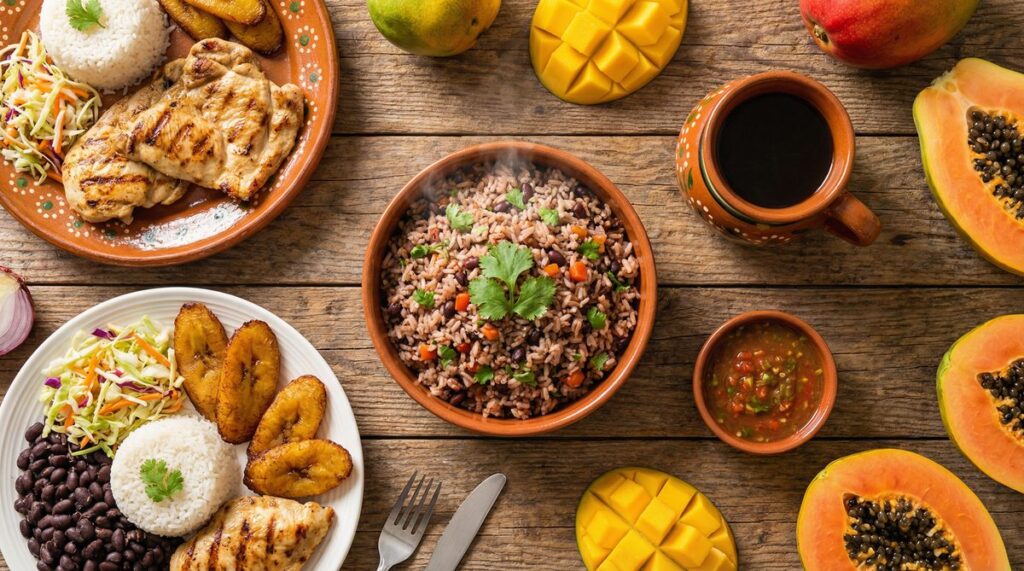
One of the most delightful surprises for newcomers to Costa Rica is the food. Not because it is flashy or complicated — Costa Rican cuisine is famously humble and honest — but because it is deeply satisfying in a way that grows on you. After a few weeks of eating gallo pinto for breakfast, casado for lunch, and olla de carne on Sunday afternoons, you begin to understand that this is a cuisine built on comfort, community, and the extraordinary agricultural abundance of a country where, as food writer Nicholas Gill puts it, “anything and everything grows.” [1]
If you are considering relocating to Costa Rica, or already spending time there, understanding the food culture will enrich your experience enormously. This guide covers the essential dishes, their history, some food trivia that will impress your tico neighbours, and — because mispronouncing your lunch order can lead to some interesting moments — a pronunciation guide for the most commonly butchered names.
The Roots of Costa Rican Cuisine
Costa Rican food is the product of three overlapping culinary traditions: the Indigenous heritage of the Chorotega and other pre-Columbian peoples, the Spanish colonial influence that arrived in the 16th century, and the Afro-Caribbean traditions brought by Jamaican labourers who came to build the railroad in the late 19th century. [2]
The Indigenous foundation is built on corn, beans, squash, and root vegetables — the same “Three Sisters” that formed the agricultural backbone of civilizations throughout the Americas. Corn appears in Costa Rican food in forms ranging from chorreadas (corn pancakes) to tamales wrapped in banana leaves, a tradition that predates Spanish colonization. Cacao, once used as currency by the Chorotega, remains important in the Caribbean coastal cuisine.
The Spanish brought pork, rice, olives, and a tradition of slow-cooked stews that merged seamlessly with Indigenous ingredients. The result was a cuisine that is neither purely European nor purely Indigenous, but a mestizo blend that feels entirely its own.
The Afro-Caribbean influence is most visible on the Caribbean coast — in Puerto Limón, Cahuita, and the Talamanca region — where coconut milk, plantains, and spices transform familiar ingredients into something distinctly different from the Central Valley cooking style. Dishes like rondón (coconut seafood stew) and patí (spiced turnovers) are the direct legacy of Jamaican workers who settled on the coast and created a vibrant culinary subculture that persists to this day.
The Essential Dishes: What to Eat and When
Gallo Pinto — The National Soul Food
Pronunciation: GAH-yo PEEN-toh (the double-L in Spanish is pronounced like a Y)
Gallo pinto — literally “spotted rooster,” a reference to the speckled appearance of black beans mixed with white rice — is the cornerstone of Costa Rican cooking. It is eaten at breakfast, lunch, and dinner, and most ticos would consider a day without it incomplete. [1]
The dish is simple: cooked rice and black beans (or red beans in Guanacaste province) sautéed together with onion, bell pepper, and cilantro, then finished with a splash of Salsa Lizano — a mild, slightly sweet Worcestershire-style sauce that is as essential to Costa Rican cooking as soy sauce is to Japanese cuisine. Salsa Lizano is the secret ingredient that elevates gallo pinto from a side dish to something genuinely craveable.
Food trivia: Both Costa Rica and Nicaragua claim gallo pinto as their national dish, and the debate over which country makes it better is a source of gentle but persistent rivalry. The Costa Rican version uses black beans and Salsa Lizano; the Nicaraguan version uses red beans and a different spice profile.
Casado — The Married Man’s Plate
Pronunciation: kah-SAH-doh
The casado is Costa Rica’s quintessential lunch plate, and it is what you will eat most often if you are living there. The name translates to “married man,” and the origin story — though disputed — holds that the dish was named for the home-cooked lunches that married men brought to work, packed by their wives. [1]
There is no single recipe for a casado. It is a combination plate built around a protein (grilled fish, stewed beef, pork chop, or fried chicken) served with white rice, black beans, a simple salad of lettuce and tomato, and usually one or two of the following: fried sweet plantains (plátano maduro), coleslaw, avocado slices, a corn tortilla, or a fried egg. Every soda (the small, family-run restaurants that are the backbone of Costa Rican food culture) makes it slightly differently, and finding your favourite version is one of the pleasures of settling in.
Olla de Carne — Sunday Stew
Pronunciation: OH-ya deh KAR-neh
If gallo pinto is the daily bread of Costa Rican cuisine, olla de carne is the Sunday feast. This slow-cooked beef and vegetable stew is the dish that brings Costa Rican families together on weekends, and the long cooking time — four to eight hours — is part of its ritual significance. [1]
Short ribs and various cuts of beef are simmered with yuca (cassava), potatoes, chayote, carrots, corn on the cob, and plantains until everything is tender and the broth is deeply flavoured. It is served with rice and beans on the side, of course. The dish is a direct descendant of Spanish cocido (a similar slow-cooked stew), adapted with the root vegetables and plantains of the New World.
Chifrijo — The Perfect Bar Snack
Pronunciation: chee-FREE-hoh
Chifrijo is Costa Rica’s answer to nachos — a bowl of fried pork (chicharrón) and red beans (frijoles) served with tortilla chips and chilera (spicy pickled vegetables). The name is a portmanteau of its two main ingredients. [1]
The dish was invented in the late 1970s at a cantina in Tibás, outside San José, and has since become ubiquitous in bars and restaurants throughout the country. It is typically served as a mid-afternoon snack or bar food, and it is one of those dishes that tastes better with a cold Imperial beer in hand.
Rondón — Caribbean Coast Treasure
Pronunciation: ron-DOHN
On the Caribbean coast, the culinary tradition is entirely different, and rondón is its crown jewel. The name comes from the English phrase “run down” — a reference to using whatever fish and vegetables the cook has managed to “run down” by the end of the week. [1]
Coconut milk forms the base of this thick stew, which might include red snapper, clams, mussels, conch, green plantains, cassava, and chiles. It was brought to Costa Rica by Jamaican labourers in the 19th century and has been adapted over generations into something distinctly Afro-Costa Rican. If you visit Puerto Limón or Cahuita, rondón is non-negotiable.
The Pronunciation Guide: Say It Like a Tico
Mispronouncing food names is a rite of passage for newcomers, but a little preparation goes a long way. Here is a quick reference:
| Dish | Pronunciation | Meaning |
|---|---|---|
| Gallo pinto | GAH-yo PEEN-toh | Spotted rooster |
| Casado | kah-SAH-doh | Married man |
| Olla de carne | OH-ya deh KAR-neh | Pot of meat |
| Chifrijo | chee-FREE-hoh | Chicharrón + frijoles |
| Rondón | ron-DOHN | Run down |
| Chorreadas | cho-reh-AH-dahs | Corn pancakes |
| Picadillo | pee-kah-DEE-yo | Vegetable hash |
| Patí | pah-TEE | Turnover/patty |
| Pejibaye | peh-hee-BAH-yeh | Peach palm fruit |
| Natilla | nah-TEE-ya | Sour cream |
| Salsa Lizano | SAL-sah lee-SAH-no | Lizano sauce |
| Soda | SOH-dah | Small local restaurant |
| Tico/Tica | TEE-koh / TEE-kah | Costa Rican person |
- The letter J is pronounced like an English H (so chifrijo is “chee-FREE-hoh”)
- Double L (ll) is pronounced like a Y (so gallo is “GAH-yo”)
- The letter Ñ is pronounced like “ny” (so piña is “PEEN-ya”)
- Costa Ricans speak relatively clearly and slowly compared to some other Spanish-speaking countries — great news for learners
Food Trivia: Impress Your Tico Neighbours
The Churchill is not British. Costa Rica’s most beloved shaved ice treat — the copo — has a variation called the Churchill, made with red kola syrup and condensed milk. It was named after a man in Puntarenas who bore a resemblance to Winston Churchill and always ordered his copo the same way. [1]
Salsa Lizano was invented in 1920. This iconic condiment, made by the Lizano company in San José, has been produced continuously since 1920 and is found on virtually every table in the country. It is available in specialty food stores internationally and is the single most important souvenir you can bring home from Costa Rica.
Costa Rican tamales are wrapped in banana leaves, not corn husks. Unlike Mexican tamales, which are wrapped in dried corn husks, Costa Rican tamales are always wrapped in banana leaves. The tamaleada — the family gathering to make tamales before Christmas — is one of the most cherished traditions in the country.
Pejibaye was a pre-Columbian staple. The orange palm fruit called pejibaye was widely cultivated across Costa Rica before Spanish colonization and was a primary food source for Indigenous communities. Today it is boiled and eaten as a snack with mayonnaise, or pureed into a rich, creamy soup. You will find it sold by street vendors throughout the Central Valley.
Costa Rica has a Blue Zone. The Nicoya Peninsula in northwestern Costa Rica is one of only five “Blue Zones” in the world — regions where people consistently live past 100 at unusually high rates. Researchers attribute this partly to the traditional diet, which is rich in beans, corn, squash, and tropical fruits, and low in processed foods. [3]
Where to Eat: Sodas vs. Restaurants
For the most authentic and affordable Costa Rican food, skip the tourist restaurants and find a soda. These small, family-run eateries are the backbone of Costa Rican food culture — unpretentious, inexpensive, and usually excellent. A full casado at a soda typically costs between 2,500 and 4,500 colones (approximately $5–$9 USD), and the quality is often better than restaurants charging three times as much.
Look for sodas with handwritten menus, plastic chairs, and a television in the corner showing the football match. These are the real ones.
Deep Dive AI Prompts
Use these prompts with ChatGPT or any AI assistant to explore this topic further:
- “What is the history of gallo pinto in Costa Rica, and why do Costa Rica and Nicaragua both claim it as their national dish?”
- “What makes the Nicoya Peninsula a Blue Zone, and how does the traditional Costa Rican diet contribute to longevity there?”
- “I’m moving to Costa Rica. What are the essential Spanish food vocabulary words I need to know to shop at markets and order in restaurants?”
- “What is Salsa Lizano and how is it used in Costa Rican cooking? Can I make it at home?”
Frequently Asked Questions
Is Costa Rican food spicy? Generally no. Costa Rican cuisine is mild by Latin American standards. Spicy condiments like chilera (pickled vegetables with chiles) are served on the side, so you control the heat. The Caribbean coast is an exception — Afro-Caribbean cooking uses more chiles and spices.
Can vegetarians and vegans eat well in Costa Rica? Yes, though it requires some navigation. Gallo pinto, picadillo, chorreadas, and many casado variations can be made without meat. In cities and tourist areas, vegetarian options are increasingly common. In rural areas, you may need to specifically request sin carne (without meat).
What is the local beer in Costa Rica? Imperial is the dominant national beer — a light, easy-drinking lager that pairs well with the tropical climate. Pilsen is another popular option. The craft beer scene has grown significantly in recent years, with breweries like Fuego Brew Co. and Cervecería Calle Cimarrona producing excellent local options.
How much does food cost in Costa Rica? Eating at sodas and local markets is very affordable — $5–$10 per meal. Mid-range restaurants in San José or tourist areas run $15–$30 per person. Imported foods and international restaurant chains are expensive by local standards.
What should I bring home from Costa Rica as food souvenirs? Salsa Lizano is the essential souvenir — it is genuinely difficult to replicate and transforms home cooking. Costa Rican coffee (particularly from the Tarrazú region) is world-class. Locally made chocolate from the Caribbean coast is also exceptional.
References
[1] Gill, N. (2021). What Is Costa Rican Food? Everything You Need to Know. Eater. Retrieved from https://www.eater.com/21516828/costa-rican-food-explainer-dishes-drinks
[2] GVI. (2023). Discovering the Culture and Cuisine of Costa Rica. Retrieved from https://www.gviusa.com/blog/smb-discovering-the-culture-and-cuisine-of-costa-rica/
[3] Buettner, D. (2024). The Blue Zones: Lessons for Living Longer from the People Who’ve Lived the Longest. National Geographic Society.